
NEWS & PRESS · U.S. ARMY
Soldiers assess new technologies at Fort Leonard Wood
U.S. Army coverage documents MSPIX 2024 and the field assessment of an aerial system designed to find subsurface explosives while keeping operators at a distance.
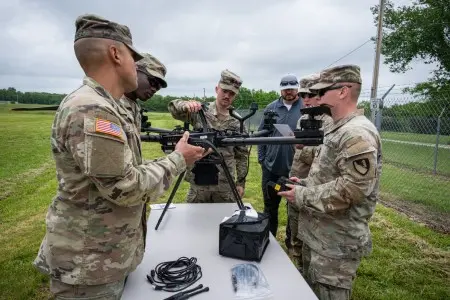
MSPIX 2024 at Fort Leonard Wood
U.S. Army institutional coverage describes the 2024 Maneuver Support and Protection Integration eXperiments, held across Fort Leonard Wood from 6 to 23 May. The programme brought soldiers, developers, researchers and experimentation staff together to assess sixteen emerging technologies. This was not a conventional exhibition. Equipment was placed in the hands of intended users so they could evaluate setup, operation and practical value under representative conditions.
The Army source emphasises the value of soldier touchpoints early in capability development. Involving the people expected to use a system can reveal factors that a purely technical trial may miss: the clarity of instructions, preparation time, compatibility with procedures, quality of the returned information and the operational workload placed on a team.
Assessing the aerial system
On 15 May, soldiers from the 16th Brigade Engineer Battalion and the 50th Multi-Role Bridge Company assessed an unmanned aircraft system programmed to locate subsurface explosives. After setting up the system, calibrating its software and preparing the aircraft, participants watched the drone sweep the designated area while data was transmitted to a computer on the ground.
The operational principle is stand-off detection: observing buried or partially buried hazards without first sending a person into the suspected location. The U.S. Army page does not attribute every technology to a specific supplier; Sierra Lobo’s release separately connects Xplora and SLIX RMDS with participation in MSPIX 2024. Xplora’s archive therefore keeps the two documents as distinct, complementary sources rather than turning institutional coverage into a commercial claim.
Why user-led validation matters
A detection system is useful only when information reaches operators in a form that supports field decisions. Soldier assessments help determine whether the path from sensor to map is understandable, timely and compatible with team activity. This question is central to Xplora’s Defence architecture and to UXO risk management: automation can reduce exposure and accelerate acquisition, while responsibility for confirming a threat and planning an intervention remains with specialists.